On this page
THE SHORT ANSWER
For a first tarot reading, make one complete record: question, cards, associations and action. Choose a real situation, then draw one or three cards. Keep names, positions and orientations separate from your interpretation. A card can suggest a useful question; it cannot testify to someone else’s thoughts or verify an external claim.
- The 78 cards describe the deck’s structure. Situation, Tension and Next Step describe Wenbu’s three positions. Read the card and its position together.
- Distinguish observation from association. “I drew the Two of Swords” and “I may be avoiding a decision” are different kinds of statement.
- End with something you can check: request information, clarify a need or try a small task. A reassuring paragraph alone leaves little to revisit.
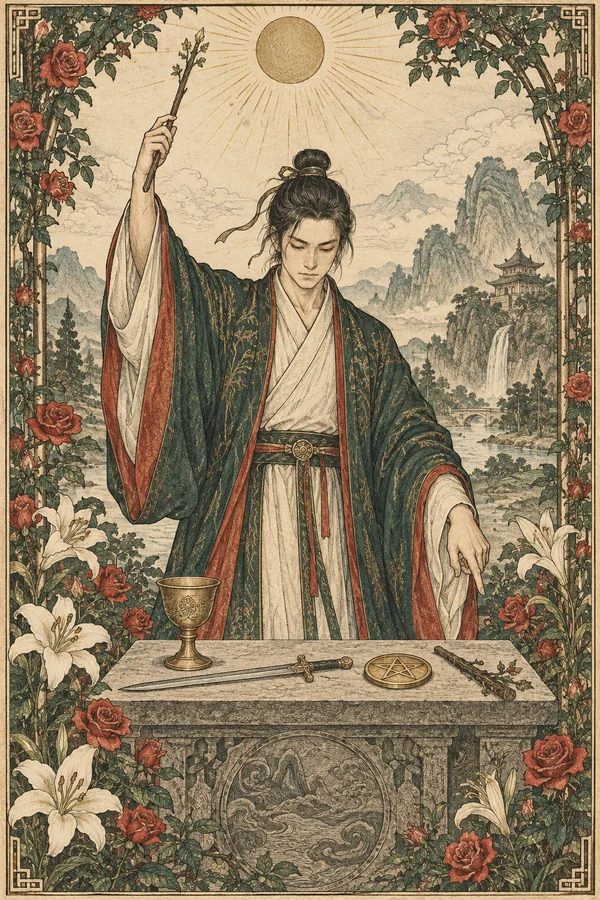 The MagicianSituation
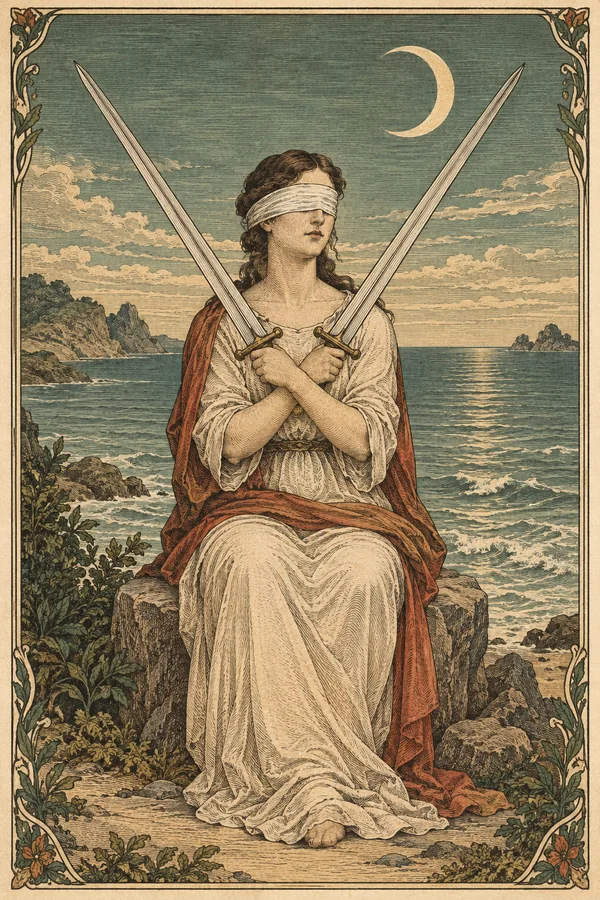 Two of SwordsTension
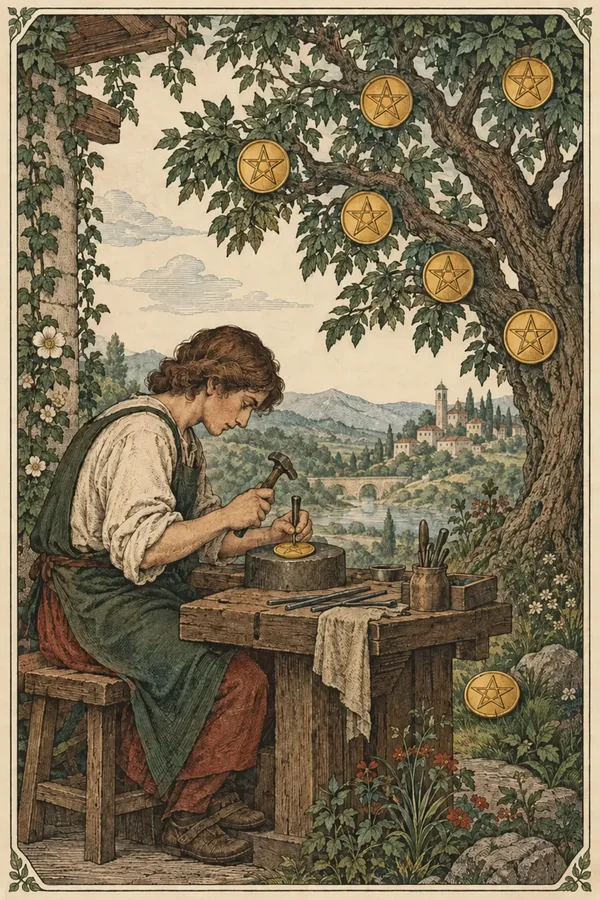 Eight of PentaclesNext step
The Magician, Two of Swords and Eight of Pentacles appear upright using Wenbu’s original artwork. These fixed examples demonstrate positions; the page has not drawn random cards for the reader.
Original AI illustrations by Wenbu. Cards selected for teaching; no random draw occurs here.Know the structure of the deck
A common Rider-Waite-Smith-style deck contains 78 cards: 22 Major Arcana and 56 Minor Arcana. The four minor suits are Wands, Cups, Swords and Pentacles. Each has Ace through Ten and four court cards.
Major cards are often read as broader themes, while minor cards invite attention to everyday situations. This convention does not mean a major event is guaranteed. Wenbu uses the full deck with original AI illustrations and short reading prompts. Its artwork is not a reproduction of the historical Rider-Waite-Smith deck.
Ask what you can notice, not what must happen
“Does this person definitely love me?” asks cards to reveal someone else’s unconfirmed feelings. “What needs am I overlooking in this relationship?” points toward something you can observe and discuss.
A useful question can include real context without demanding a reassuring answer. When considering a job, for example, ask which conditions beyond salary deserve attention. The cards can start an association; evidence still comes from real information.
Four layers to keep in your reading record
| Layer | Example | What you can check |
|---|---|---|
| Context | Proposing a small trial project with a friend | Goal, time available and known constraints |
| Drawn result | Situation: The Magician, upright | Name, orientation and position |
| Association | Perhaps I already have enough resources for a sample | Inventory the resources; this is a hypothesis |
| Action | Make a one-page sample by Friday and confirm its scope | Completion and the other person’s response |
On a small screen, scroll the table sideways.
Three cards, three perspectives
Wenbu’s spread uses Situation, Tension and Next Step. These positions organize reflection rather than claim fixed knowledge of past, present or future events. Cards are drawn without replacement, so a spread cannot contain duplicates.
With reversals enabled, each card independently has a 50 percent chance of appearing reversed. Read reversal as a possible blockage, internal focus or imbalance, not automatically as something bad. A reading without reversals is also a valid reflective practice.
Record before elaborating
Write down the card names, positions and orientations before interpreting them. Add “This reminds me of…” and one small action. The distinction makes it easier to see where an association came from.
Return later and record what did not fit as well as what did. Tarot may support reflection, but it cannot replace conversation with the people involved or qualified advice about health, law and money.
A first reading can be one card
Try a question such as: “What should I consider before a conversation this week?” Draw one card, note an association, and write one question you still need to ask the person involved. If nothing comes to mind, you do not need to force a connection.
Next, learn the suits and court cards, then compare approaches to reversals. Keep the first result rather than redrawing until you like it. New information or a changed question can give a later session a clearer purpose.
Turn three cards into a useful project note
Use the question: “What should I clarify before trying a project with a friend?” Work with the three fixed cards in the illustration. This exercise is about recording a reading, not engineering a favorable draw.
For Situation, record The Magician upright. Make “resources” concrete: relevant skills, tools and hours available. Do not jump from the image to a claim that the project will succeed.
For Tension, use the Two of Swords to ask whether a decision is unresolved. Check the actual context: perhaps nobody has agreed who approves the scope. If a decision-maker is already confirmed, cross out that association.
For Next Step, turn the Eight of Pentacles’ practice theme into a small task: produce one sample page before committing to the entire project.
Write one sentence: “This week I will make a sample with existing tools and confirm who approves the scope.” List missing information, including your friend’s availability and the feedback deadline.
Revisit the record on Friday. Note whether the sample was finished, what the person actually said and which associations did not fit. Keep the original wording so later events do not rewrite the reading.
The result is a clearer preparation for a conversation. Give an Agent the original question and spread positions so it can help clarify your record without inventing another draw or another person’s motives.
Key terms
- Major Arcana
- The 22 major cards in a common Rider–Waite–Smith-style deck; a deck category, not a severity rating.
- Spread position
- A question assigned before drawing, such as Situation or Next Step, which gives a card its immediate context.
- Without replacement
- Once drawn, a card cannot appear again in the same spread. This is separate from the reversal setting.
Common questions
Must I memorize all 78 cards first?
No. Learn the broad categories, the four suits and the positions you are using. One card is enough for an exercise. Look up unfamiliar cards in a named source and return to the question rather than collecting disconnected keywords.
Does Death or The Tower mean something terrible will happen?
Dramatic imagery can produce a strong association, but it supplies no evidence of an event. Check the deck and text, then identify any change or instability already supported by real information. You do not need to invent a disaster to make the picture fit.
Are the seven card backs the only available cards?
No. They provide the selection interaction. Wenbu draws from all 78 cards without replacement, so three cards in one spread cannot repeat. A clickable position is not a fixed hidden card that you can reliably predict.
Sources and their scope
Primary text for Waite’s card entries and reversal conventions. The exercises here are original Wenbu prompts, not translations.
Museum account of deck structure and historical context, separate from modern reflective exercises.
Supports the 78-card draw without replacement and the three spread positions.
Documents the seven-back selection interface, card-count control and reversal setting.
Further reading; not validation of real-world predictions.
Further reading; not validation of real-world predictions.
Traditional interpretations are not established predictions. See the source notes for context.
Read this guide with your agent
Get the complete text, diagram descriptions and sources in an open format. These files contain public knowledge only.
Ready to put this into practice?
Try a tarot reading ↗