On this page
THE SHORT ANSWER
A reversal means a card appears upside down relative to the reading direction. It does not automatically mean bad news or the opposite of every upright meaning. Choose a convention before drawing. In Wenbu, beginners can turn off “Include reversed cards,” then introduce reversals later with a clearly named approach or source.
- Orientation belongs to the draw record; meaning belongs to interpretation. Keep the original orientation instead of changing it to suit a conclusion.
- With reversals on, each card has an independent 50% chance of reversal. Three reversed cards occur with probability 1/8; the system has not assigned your luck a low score.
- Historical authors offer specific reversal entries. Blockage, excess and inward focus are possible reflective approaches, not one universal historical rule.
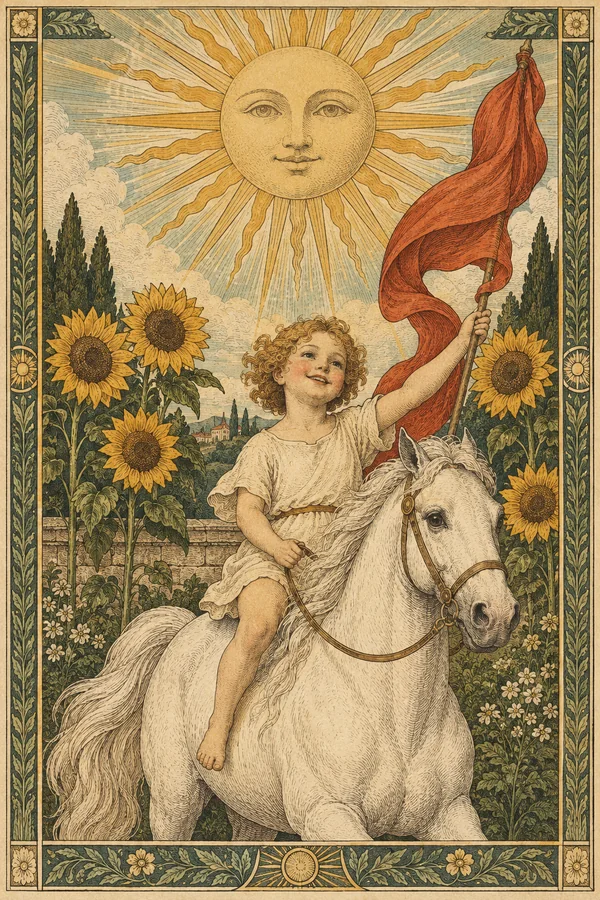 The Sun · uprightThe Sun · reversed
The upright Sun appears beside the same illustration rotated 180 degrees; both name labels remain readable. Waite’s reversed Sun retains the upright theme in a diminished form, illustrating why reversal need not mean its opposite.
Original AI illustrations by Wenbu. Cards selected for teaching; no random draw occurs here.A reversal begins as an orientation
A reversed card appears upside down relative to the reading direction. With reversals enabled in Wenbu, each drawn card independently has a one-in-two chance of being reversed. With the setting off, all cards appear upright. This is a draw convention, not a measurement of your luck.
Several reversed cards in a spread are a possible result of that random process. They do not mean the system has rated your situation poorly or that you need another draw immediately.
Choose an approach and name it
Some sources give specific upright and reversed meanings for each card. Modern reflective approaches may consider a blockage, excess, an inward focus or something unfinished. These are interpretive choices. A reversal does not mechanically turn every upright meaning into its opposite.
You can turn reversals off while learning names, suits and spread positions. Or keep them on and use one clearly stated approach for the session. Neither setting needs to be presented as more accurate.
Name the approach before using it
| Approach | A question to ask | A leap to avoid |
|---|---|---|
| Upright only | How do the card and position address the question? | Assuming all remaining meanings are positive |
| Blocked | What real condition could hinder this theme? | Inventing an obstructive person without evidence |
| Excess or lack | Is something overdone or underdeveloped? | Using one phrase to explain every possible outcome |
| Inward focus | Is this mainly an internal concern? | Claiming access to another person’s hidden feelings |
| Source-specific entry | What does this author say about this card reversed? | Mixing authors without identifying them |
On a small screen, scroll the table sideways.
Make an idea such as “blocked” specific
Suppose you are trying to start a project and a reversal suggests stalled action. Ask what might be getting in the way: an oversized task, limited time or a missing confirmation. Check each possibility against your situation rather than inferring it from the card’s orientation.
You could write: “I read this reversal as difficulty getting started. I am still waiting for essential information, so I will ask when it is available.” If you find no relevant obstacle, “This angle does not fit right now” is an equally useful note.
Set the rules before drawing
Choose one or three cards, decide whether to include reversals, and write your question. Wenbu’s three positions are Situation, Tension and Next Step. Keep those positions and orientations as drawn rather than rearranging them after seeing the result.
For your next practice, take one card and write a question its upright meaning might prompt, then one its reversed meaning might prompt. Keep the question most relevant to your circumstances. You are comparing ways to reflect, not deciding which orientation brings better luck.
Compare a diminished theme with a “bad outcome”
Use The Sun as a fixed study card. Ask: “How can I present my work clearly this weekend?” No new random result is being generated in this exercise.
State the rule: “I am comparing Waite’s Sun entries.” Check the upright and reversed descriptions in that text instead of assuming every online Sun description belongs to the same tradition.
For the upright card, an association with showing your work might prompt an inventory: the demo you have, the part that needs rehearsal and the one point the audience should remember.
For the reversal, explore a similar theme that is less fully expressed. Try the hypothesis: “The work is ready, but I have not found a clear way to explain it.” Treat this as a possibility, not an established fact.
Test it by asking a friend to watch a two-minute demonstration and repeat the main point. If they understand, note that the hypothesis did not fit. If they do not, revise the opening or add an example.
Keep the orientation, source, hypothesis and feedback together. One unclear explanation does not establish that the whole event will fail. A fresh draw is not needed to remove an uncomfortable feeling.
The useful difference is the check the reading suggests. Keeping the convention stable makes review possible; sorting orientations into a good column and a bad column does not.
Key terms
- Upright
- Shown in the agreed normal reading direction; not a guarantee of a positive interpretation.
- Reversed
- Shown upside down relative to that direction, interpreted according to a stated convention.
- Reading convention
- The spread, reversal choice and interpretive approach fixed before drawing, so the record remains comparable later.
Common questions
Does Wenbu currently default to upright-only readings?
No. “Include reversed cards” is currently enabled on the tool page, and the API defaults an omitted reversals field to true. Uncheck the setting before drawing, or explicitly send reversals: false through an Agent or API. Existing records keep their original orientations.
Are three reversals a bad result?
With reversals enabled, that combination has a 12.5% probability. Check the setting and read each card using the convention chosen beforehand. The reversal count does not measure emotional health, relationship quality or luck.
Can I view a reversed image upright to inspect its details?
A separate upright reference image can help, but retain the original reversed label in your record. Display orientation and recorded orientation are different things. Silently changing the record prevents another reader or Agent from checking the reading you actually made.
Sources and their scope
Primary text for Waite’s card entries and reversal conventions. The exercises here are original Wenbu prompts, not translations.
Supports independent 50% reversal sampling; the three-reversal probability follows from this rule.
Documents the default for an omitted reversals parameter and explicit false for upright-only draws.
Documents the current browser default and the user-facing reversal control.
Traditional interpretations are not established predictions. See the source notes for context.
Read this guide with your agent
Get the complete text, diagram descriptions and sources in an open format. These files contain public knowledge only.
Ready to put this into practice?
Try a tarot reading ↗