On this page
THE SHORT ANSWER
A suit supplies a field of attention; a court rank can suggest an approach. Combine both with the particular card, its spread position and your question. Wands, Cups, Swords and Pentacles each have 14 cards, including Page, Knight, Queen and King. Reading those ranks as approaches is a learning exercise, not a rule for identifying people.
- Classify the card first: major, numbered minor or court card. Then read its position. One keyword cannot do the work of the whole spread.
- The suits are not exclusive compartments. Work involves feelings and relationships; relationships also require time, skills and practical care.
- Court titles preserve historical roles. A reflective exercise does not require assigning people a gender, age or fixed identity from a card.
 Wands
 Cups
 Swords
 Pentacles
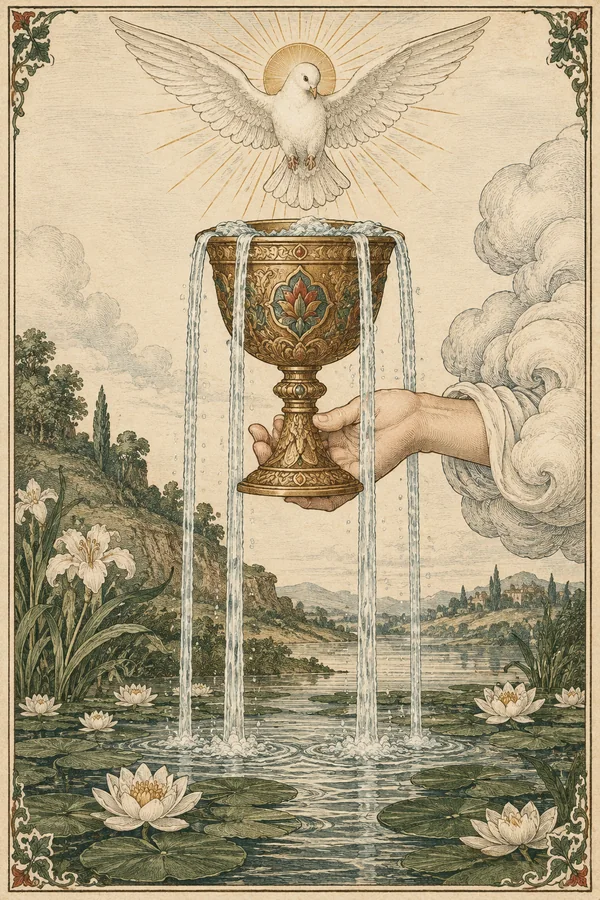
Wenbu’s original Aces of Wands, Cups, Swords and Pentacles introduce the four suits. Each shares the same rank but opens a different question. These modern illustrations are not evidence for every symbol in the historical Rider–Waite–Smith deck.
Original AI illustrations by Wenbu. Cards selected for teaching; no random draw occurs here.Learn the deck’s structure first
A typical Rider-Waite-Smith-style deck has 22 Major Arcana and 56 Minor Arcana. The minor cards have four suits. Each contains Ace through Ten, followed by Page, Knight, Queen and King.
A suit gives you a starting point. The particular card, its spread position and your question add context. Treating every Cup as romance or every Pentacle as income leaves out other useful ways to read the image.
Use the suits to ask different questions
These are Wenbu’s modern reflection prompts for beginners, rather than an exhaustive account of historical card meanings.
- Wands: action, motivation and effort. Why begin this project, and how much energy can I give it?
- Cups: feelings, relationships and responses. Whose needs have not been heard? What do I expect from a collaboration?
- Swords: thought, judgment and communication. Which facts are established, and where is the disagreement?
- Pentacles: resources, practice and everyday work. Do my time, skills and budget support the plan?
Turn a suit or court rank into a question
| Clue | Approach used in this exercise | A question for your record |
|---|---|---|
| Wands | Motivation, action, sustained effort | What am I willing to keep doing? |
| Cups | Feelings, relationships, responses | Which needs have not been expressed? |
| Swords | Judgment, language, disagreement | What is fact, and what is an assumption? |
| Pentacles | Resources, skills, daily practice | What do my current resources support? |
| Page | Learning through questions | Which basic point should I understand first? |
| Knight | Putting something into motion | What needs to move, and at what pace? |
| Queen | Tending a process and developing skill | What would make this sustainable? |
| King | Organizing and taking responsibility | Who decides, and who carries the cost? |
On a small screen, scroll the table sideways.
Try reading a court card as an approach
A court card need not represent a particular person, age or gender. For a first exercise, read a Page as learning or trying, a Knight as pursuing or acting, a Queen as tending or developing a practice, and a King as organizing or taking responsibility. Refine that starting point with the suit and the particular image.
For example, the Page of Pentacles could prompt: “What basic skill would help this project most?” You do not need to conclude that a young person is about to appear. If someone comes to mind, record that as your association rather than a confirmed identity or motive.
Try an exercise before checking the card meaning
Suppose your question is how to begin a personal project. Pick a card, name its suit, note an action or image that catches your attention, and connect it to one practical condition. For instance: “Pentacles → learning through practice → two hours this week to make a small prototype.”
Then read the prompt and note what it adds, including anything that does not fit. Wenbu uses original AI illustrations, so every decorative detail need not carry a meaning from a historical Rider-Waite-Smith image. Consult the relevant original deck and text when studying that imagery.
One project, four approaches: the Pentacles court
Imagine preparing a small craft stall. This fixed comparison is a study exercise, not a four-card draw or a financial forecast. Keep resources and practice as the shared subject.
As a Page, identify a basic unknown: package dimensions or the material cost per item. Make one sample and record what it uses before estimating a whole batch.
As a Knight, consider repeatable effort. Establish how many pieces you can reliably finish each day instead of promising a volume supported only by enthusiasm.
As a Queen, inspect the working conditions. Storage, rest, presentation and help from others may make the process easier to sustain.
As a King, clarify responsibility and limits. Agree who manages stock, what the spending ceiling is and when to stop adding commitments. These are practical management questions.
In an actual spread, return to the card and position that were drawn. If an approach does not fit the situation, record that. You do not need to make every role apply.
The exercise builds a memory aid from suit and approach. It is not a ladder of maturity. Individual cards and historical entries contain distinctions that you will still need to study separately.
Key terms
- Suit
- One of the four Minor Arcana series, each containing numbered cards and court cards.
- Court card
- A Page, Knight, Queen or King in a common Rider–Waite–Smith-style deck; not automatically a real person.
- Numbered minor
- An Ace-through-Ten card. The same rank in different suits does not guarantee the same meaning.
Common questions
Do Pentacles always mean money and Cups always mean romance?
That is too narrow. Here, Pentacles invite practical questions and Cups invite questions about feelings and responses. A family discussion can involve budgets; a work project can involve disappointment. Begin with the situation before choosing an association.
Can a King identify a particular man?
A court card alone cannot establish someone’s gender, age, job or motives. You can write that it reminds you of a person and explain the real experiences behind that association. That is different from claiming the card has identified them.
What if another deck uses Coins or Disks?
Names and systems vary. Save the deck name and original card title rather than merging entries on a translated label alone. Wenbu uses Pentacles. When studying a different system, consult the guide for that deck first.
Sources and their scope
Primary source for the suits and court ranks. The role-based questions are an original teaching framework.
Primary text for Waite’s card entries and reversal conventions. The exercises here are original Wenbu prompts, not translations.
Documents Wenbu’s card names and original prompts, which are not presented as literal translations of a classic.
Traditional interpretations are not established predictions. See the source notes for context.
Read this guide with your agent
Get the complete text, diagram descriptions and sources in an open format. These files contain public knowledge only.
ADDITIONAL PRACTICE · 2026-11-07
Does a court card have to be a person? A three-sentence rewrite drill from a declared position
Does a court card have to mean a person? A three-layer exercise
No. A court card can suggest an approach or a role that needs attention, but it cannot confirm a real person's gender, age, job or motives. A safer practice keeps three readings separate: a person reading is written only as “this reminds me of someone,” with the real experiences behind the association; a role reading asks which function is missing in the situation; a behavior reading asks what concrete step comes next. The three can coexist, but each must return to information you can check rather than treating the card as an identity verdict.
Current en canonical article — preserve it and add a distinct useful exercise ↗Wenbu · tarot beginner guide ↗A. E. Waite · The Pictorial Key to the Tarot, Part III ↗
- A court card can be read as a person, a role or a behavior, but the three must be recorded separately and never borrow each other's authority.
- A person reading stays a personal association with stated real-world grounds; it cannot establish a stranger's identity or motives.
- Role and behavior readings are easier to check against reality and work well as the main line of an exercise.
A three-layer record for one court card
- 01Fix the card
Write the card name, suit, orientation and spread position before interpreting.
- 02Write the person association
If someone comes to mind, write “this reminds me of,” and note the real experiences behind it.
- 03Write role and behavior
Ask which function is missing, then turn it into one small step for this week.
- 04Check against reality
Record whether the step was done, what the other person actually said, and which associations failed.
Current en canonical article — preserve it and add a distinct useful exercise ↗Wenbu · tarot beginner guide ↗
Separate what each reading is actually saying
One court card can sit inside at least three different sentences. A person reading says, “this reminds me of someone.” A role reading says, “this situation seems to lack someone who closes the loop.” A behavior reading says, “this week, try one small step that can be checked.” The three sentences do not carry the same evidential weight: the person reading is most easily mistaken for a verdict about someone, while the behavior reading is easiest to test in real life. Writing them on separate lines keeps them from blending into one confident-sounding claim.
The existing article already notes that court titles preserve historical roles and that a reflective exercise does not require assigning people a gender, age or fixed identity. That boundary applies to all three readings: a card can supply a question, but a person's identity, motives and circumstances are confirmed only by real information. Keeping “this reminds me of” apart from “the card has identified” is the most practical move in this section.
Current en canonical article — preserve it and add a distinct useful exercise ↗Wenbu · tarot beginner guide ↗
The person reading: downgrade association to hypothesis
The person reading is not forbidden; it just needs downgrading. If a court card brings a colleague to mind, write “this card reminds me of him,” then add where the association comes from: did he keep confirming details in the last meeting, or does he usually appear at the closing stage? That gives the association a traceable source and lets later events support or overturn it. Writing only “the card says he is this kind of person” dresses a private association as an external conclusion.
Waite's historical entries do connect court cards with types of people; the Cups King entry, for instance, lists “Fair man, man of business” among its divinatory meanings. That is a traditional way of writing inside a historical text and can be studied as such, but it is not an identification of a particular living person and not evidence about anyone's character. A modern reflective exercise can keep the historical wording with its source while declining to apply it directly to people around you.
A. E. Waite · The Pictorial Key to the Tarot, Part III ↗Current en canonical article — preserve it and add a distinct useful exercise ↗
Role and behavior readings: land the card on checkable action
A role reading asks about functions, not people. Suppose a three-person group must submit a proposal; with a court card drawn, ask which function is covered: who is learning new information, who is pushing the schedule, who is tending the process, who carries the final decision? These questions test whether responsibilities are clear rather than labeling a member. If a function already has an owner, cross it out; if nobody owns it, list it as something to confirm.
A behavior reading goes one step further and turns the function into a concrete action. “Someone needs to tend the process” can become “confirm this week where materials are stored and when they change hands.” The existing Pentacles court exercise follows this logic: a Page identifies a basic unknown, a Knight checks repeatable effort, a Queen inspects working conditions, and a King clarifies budget and responsibility. These are four approaches to check separately, not a ladder of maturity.
Current en canonical article — preserve it and add a distinct useful exercise ↗Wenbu · tarot beginner guide ↗
Put all three readings in one record
A clear record can use three columns: card and position, my association, and a checkable action. The first column holds only the card name, orientation and spread position, with no interpretation. The second holds person, role or behavior associations, labeled by type. The third holds one next step that can be checked in reality. The aim is not to make reading mechanical but to give each kind of sentence its own place, so that later you can tell which line reality supported and which was only an image at the time.
Uncertainty should stay visible. The same card may prompt different things under different questions, and an association that does not fit is normal; writing “not applicable” is more useful than forcing an explanation. Cards do not replace conversation with the people involved, nor qualified advice on health, law or money. Treating a court card as the start of a question rather than the end of an answer is what makes this exercise hold up.
Wenbu · tarot beginner guide ↗Current en canonical article — preserve it and add a distinct useful exercise ↗
| Reading | Typical question | What it offers | What to avoid |
|---|---|---|---|
| Person | Who does this card remind me of? | A traceable personal association | Declaring someone's identity, motives or character |
| Role | Which function is missing here? | A check on division of duties | Assigning the function straight to a member |
| Behavior | What small step comes next? | An action that can be done and reviewed | Treating the action as a guaranteed outcome |
| Record | How do I keep the three apart? | Grounds you can revisit later | Blending association and fact into one sentence |
Current en canonical article — preserve it and add a distinct useful exercise ↗Wenbu · tarot beginner guide ↗
Hypothetical scene: a three-person group prepares a community-event proposal
The following is a hypothetical practice scene, not an actual draw, and it involves no real people. Suppose you and two partners must submit a community-event proposal within two weeks, and you draw one court card and want to know how to use it.
- First, record only the card: write its name, suit, orientation and spread position, with no interpretation yet.
- Second, write the person association: if the card brings a partner to mind, write “this reminds me of her,” and note whether it is because she handled sign-up counts last time or because she often raises objections in discussion.
- Third, write the role question: ask which function the proposal currently lacks—who checks venue times, who assembles the budget, who signs off the final draft. Cross out functions already owned and list the rest as to confirm.
- Fourth, write the behavior step: turn one unowned function into a small task for this week, such as “confirm the venue's available times by Wednesday and reply in the group.”
- Fifth, review two days later: record whether the task was done, what partners actually said, and which person association reality supported or overturned.
At the end you do not have a conclusion about what kind of person a partner is, but a record containing the card, associations and open tasks. The person association can stay, but it remains a hypothesis; what moves the proposal forward is the actions written clearly enough to check.
Current en canonical article — preserve it and add a distinct useful exercise ↗Wenbu · tarot beginner guide ↗
Questions you may have
If I draw a King, does that mean the team has a male leader?
No such inference follows. Court titles come from historical roles, and the card cannot confirm anyone's gender, age or position. You can note “this card reminds me of a decision-making role,” then check in reality who actually makes decisions and carries the cost; if someone already does, mark the association as not applicable.
Current en canonical article — preserve it and add a distinct useful exercise ↗A. E. Waite · The Pictorial Key to the Tarot, Part III ↗
Is the person reading ever allowed?
It can be used, but downgraded to a hypothesis. Write “this reminds me of someone, because of a specific experience,” and let later information overturn it. Waite's historical text does connect court cards with types of people; that is a traditional way of writing, not an identification or judgment of a particular living person.
A. E. Waite · The Pictorial Key to the Tarot, Part III ↗Wenbu · tarot beginner guide ↗
Do I have to fill in all three readings?
No. The three readings are checking angles, not a checklist to complete. If a person association does not fit, write that it does not apply; if the role question is already clear, move straight to a behavior step. Leaving a blank is more honest than forcing an explanation.
Current en canonical article — preserve it and add a distinct useful exercise ↗Wenbu · tarot beginner guide ↗
Terms in this guide
- Court card
- A Page, Knight, Queen or King in a common Rider–Waite–Smith-style deck; it can suggest a role or approach but does not automatically correspond to a real person.
Current en canonical article — preserve it and add a distinct useful exercise ↗
- Person reading
- A reading that links a court card to a real person; in practice it should be written as a personal association with stated grounds, not as a verdict about that person.
- Behavior reading
- Turning a card's prompt into a concrete, small action that can be completed and reviewed in reality, rather than a predicted outcome.
See the claim and source notes
The existing article frames reading court ranks as approaches as a learning exercise, not a rule for identifying people.
Reading those ranks as approaches is a learning exercise, not a rule for identifying people.
Current en canonical article — preserve it and add a distinct useful exercise ↗
Wenbu's beginner guide separates the drawn card from personal association and says a card cannot verify someone else's thoughts.
A card can suggest a useful question; it cannot testify to someone else’s thoughts or verify an external claim.
Waite describes the court cards as conventional figures forming a transition, not as one-to-one portraits of real people.
they are a bridge of conventions
Sources and review scope
This AI-assisted Wenbu article passed automated structure checks and a separate editorial model pass. It is not independent expert review or a paid-account product test.
- Current zh canonical article — preserve it and add a distinct useful exercise ↗Existing article, not a new external source. Avoid repeating its explanation. · 2026-10-21 · Fetched text
- Current en canonical article — preserve it and add a distinct useful exercise ↗Existing article, not a new external source. Avoid repeating its explanation. · 2026-10-21 · Fetched text
- Wenbu · tarot beginner guide ↗Existing editorial and worked reading · 2026-10-21 · Fetched text
- A. E. Waite · The Pictorial Key to the Tarot, Part III ↗Waite primary text on card entries and reversals; historical symbolic interpretations, not evidence of predictive accuracy · 2026-10-21 · Read excerpt
Try a three-layer record
Next time you draw a court card, write three lines—card facts, a person association and one checkable step—then look back in two days to see which line holds up.
Try a three-layer record ↗No. To practise role and behavior rather than identity, put the card back into the position where it was drawn: record the card name, suit, orientation and the position question first, then write three rewrites of that same question. The person sentence says only “this reminds me of someone, because of a specific experience.” The role sentence names which function the position lacks. The behavior sentence states one action you can finish and review this week. Then take only the behavior sentence into reality. Mark the person association not applicable in two cases: you cannot name any concrete experience behind it, or the function already has a clear owner and needs no discussion. The label does not deny the association; it records that the association cannot be tested right now.
Current complete en canonical article ↗Wenbu · tarot beginner guide ↗A. E. Waite · The Pictorial Key to the Tarot, Part III ↗
- The drill starts from the spread position, not the card name: the same court card in a different position changes both the role sentence and the behavior sentence.
- All three rewrites answer the same position question, so the comparison tests reading styles rather than three different questions.
- Keep a person association only when it has a traceable experience and the function is still open; otherwise mark it not applicable.
Re-reading one court card: from position to three rewrites
- 01Fix card and position
Record the card name, suit, orientation and the question written for that position before drawing; do not change it.
- 02Write three rewrites
Person: association plus specific basis. Role: which function is missing. Behavior: one small action for this week.
- 03Judge the person sentence
Mark not applicable if there is no concrete basis, or the function already has a clear owner and needs no discussion.
- 04Run only the behavior sentence
Take it into reality and review completion and the other person's actual response two days later.
Current complete en canonical article ↗Wenbu · tarot beginner guide ↗
The drill: one card, one position, three rewrites
Fix the facts first: card name, suit, orientation, and the spread position with the question you wrote for it before drawing. That position question decides what all three rewrites answer, so do not revise it after seeing the card. Suppose the position is Next Step and the question reads “what is the smallest action I can finish alone this week?” All three rewrites then circle that action instead of drifting apart.
Next, write the three sentences. Person: who does this card remind me of, and which specific experience is the basis? Role: to complete this action, is the missing function learning, pushing, tending the process or carrying the decision? Behavior: turn that missing function into one small action you can finish and review this week. Keep them on separate lines, labeled by type, so they do not merge into one confident-sounding claim. Take only the behavior sentence into reality and check it two days later.
The drill does not judge anyone's identity or motives. The card supplies a question; the person sentence stays a hypothesis. If a sentence will not come, leaving it blank is more honest than forcing one.
Current complete en canonical article ↗Wenbu · tarot beginner guide ↗
When to mark the person association not applicable
The rule can be short enough to apply every time. First case: someone comes to mind but you cannot name any concrete experience behind it, only a feeling of resemblance. Mark the person sentence not applicable, because later information cannot test it. Second case: the function named in the role sentence already has a clear owner and there is nothing to discuss, so reading the card as a particular person only repeats a settled division of labor. Mark it not applicable too.
Conversely, if the function is unowned or its ownership is worth discussing, the person association can stay as a hypothesis with its basis written down. Not applicable does not mean the association was wrong; it means it cannot move this reading forward now. Waite's entries do connect court cards with types of people, but that is a traditional way of writing in a historical text and cannot confirm the identity or character of anyone around you.
Current complete en canonical article ↗A. E. Waite · The Pictorial Key to the Tarot, Part III ↗
Write the rewrites into a table you can revisit
The drill earns its keep only if you can later tell which sentence held up. Keep the original wording; do not polish it afterwards into “I knew it.” Two days on, ask: was the behavior sentence completed? What did the other person actually say? Was the basis for the person sentence supported or overturned? Did the gap named in the role sentence really exist? Write the answers beside the original lines rather than rewriting them.
If the behavior sentence turns out vague, such as “communicate more,” return to the role sentence, ask which function is actually missing, and replace it with something you can tick off. If reality overturns the person sentence, keep it and note what overturned it; that is itself a result. Cards do not replace conversation with the people involved, nor qualified advice on health, law or money.
Wenbu · tarot beginner guide ↗Current complete en canonical article ↗
| Sentence type | How to write it | When to keep it | When to mark not applicable |
|---|---|---|---|
| Person | This reminds me of someone, because of a specific experience | A traceable basis exists and the function is still open | Only a feeling with no basis, or the function already has a clear owner |
| Role | Which function does this position lack? | It maps to a real gap in the division of duties | Real information already rules the gap out |
| Behavior | One action I can finish and review this week | It is specific enough to tick off | It is vague and needs rewriting from the role sentence |
| Review | Compare against the original wording after two days | Record what supported and what overturned each line | Polishing the original sentences afterwards |
Current complete en canonical article ↗Wenbu · tarot beginner guide ↗
Hypothetical scene: one court card while preparing a reading group
The following is a hypothetical exercise, not an actual draw, and it involves no real people. Suppose you and two friends are organizing a small reading group. The Next Step position question was written in advance as “what is the smallest action I can finish alone this week?”, and you draw a court card in that position.
- First, record only the card: name, suit, orientation and the position question, with no interpretation yet.
- Second, write the person sentence: if the card brings a friend to mind, write “this reminds me of her,” and note the basis, such as her sorting the sign-up sheet last time.
- Third, write the role sentence: for this week's smallest action, which function is missing—confirming the room time, assembling the reading list, or deciding who handles sign-in?
- Fourth, write the behavior sentence: turn the missing function into a tickable action, such as “message the venue by Thursday to confirm the available slot.”
- Fifth, judge the person sentence: if that friend has nothing to do with the venue and someone else already confirmed it, mark the person sentence not applicable and keep only the role and behavior sentences.
- Sixth, review two days later: was the action done, what did the venue actually reply, and which sentence was supported or overturned? Record it beside the original wording.
You end with a record that carries a judgment, not a conclusion about what kind of person a friend is. The person sentence may stay or be marked not applicable; what moves the reading group forward is the action specific enough to tick off.
Current complete en canonical article ↗Wenbu · tarot beginner guide ↗
Questions you may have
If I move the same court card to another spread position, do the three rewrites change?
Yes. A different position question changes the function the role sentence looks for and the action the behavior sentence proposes. Fix the position question before writing the three sentences; if you change position, treat it as a new exercise and record it fresh rather than reusing the old lines.
Current complete en canonical article ↗Wenbu · tarot beginner guide ↗
Does marking the person sentence not applicable mean I read it wrong?
No. The label means the association cannot be tested right now, or it repeats a division of labor already settled in reality. Keeping the original sentence with the reason is more useful than deleting it, because the review shows what you were relying on at the time.
Current complete en canonical article ↗Wenbu · tarot beginner guide ↗
Waite wrote court cards as types of people; does that support the person reading?
That is a traditional way of writing in a historical text. It can be studied as such, but it is not an identification of a particular living person and not evidence about anyone's character. A modern exercise can keep the source while declining to apply it directly to people around you.
A. E. Waite · The Pictorial Key to the Tarot, Part III ↗Current complete en canonical article ↗
Terms in this guide
- Re-reading drill
- Taking one drawn court card in its declared spread position and rewriting it as a person sentence, a role sentence and a behavior sentence, then judging whether the person sentence applies.
- Not-applicable mark
- A note that a person association lacks a concrete basis, or that the function it points to already has a clear owner, so the sentence is kept but not used to interpret anyone.
See the claim and source notes
The existing article frames reading court ranks as approaches as a learning exercise, not a rule for identifying people; this page moves that exercise onto a declared spread position.
Reading those ranks as approaches is a learning exercise, not a rule for identifying people.
Wenbu's beginner guide requires recording card names, positions and orientations before interpreting, and says a card cannot verify another person's thoughts.
Write down the card names, positions and orientations before interpreting them.
Waite calls the court cards a bridge of conventions, indicating a traditional naming convention rather than identification of particular people.
they are a bridge of conventions
Sources and review scope
This AI-assisted Wenbu article passed automated structure checks and a separate editorial model pass. It is not independent expert review or a paid-account product test.
- Current complete zh canonical article ↗Current public original and earlier additions; add substantial coverage without repeating or replacing them. · 2026-11-07 · Fetched text
- Current complete en canonical article ↗Current public original and earlier additions; add substantial coverage without repeating or replacing them. · 2026-11-07 · Fetched text
- Wenbu · tarot beginner guide ↗Existing editorial and worked reading · 2026-11-07 · Read excerpt
- A. E. Waite · The Pictorial Key to the Tarot, Part III ↗Waite primary text on card entries and reversals; historical symbolic interpretations, not evidence of predictive accuracy · 2026-11-07 · Read excerpt
Run the drill on one drawn court card
Draw once in Wenbu's tarot tool, choose a position, write the three rewrites against that position question, mark the person sentence keep or not applicable, and check the behavior sentence two days later.
Run the drill on one drawn court card ↗